Can You Get the Brain Benefits Without the Trip?
New mouse research separates some of psilocybin's brain changes from a trip-associated behavior. It opens a big question—not a proven shortcut to healing.
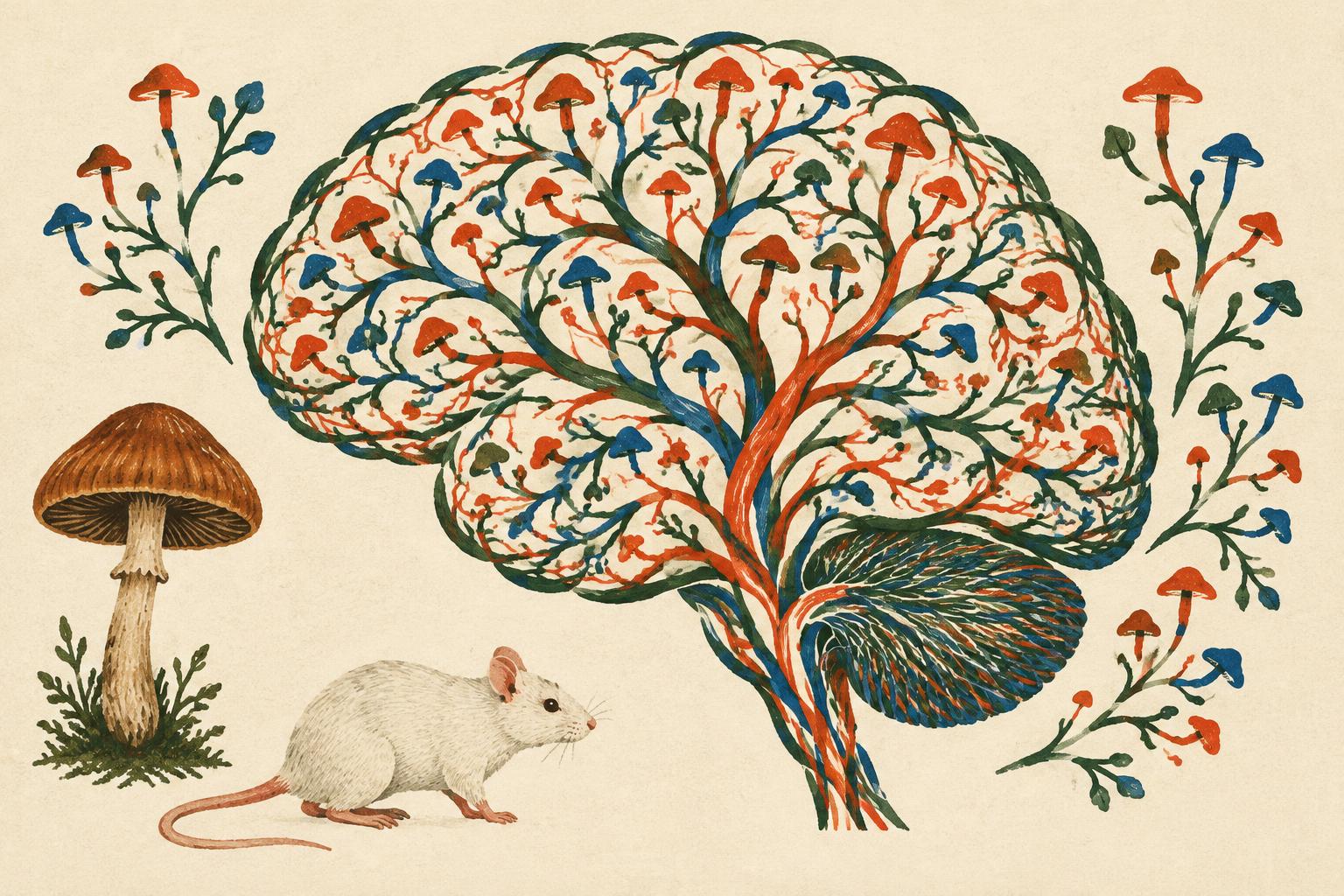
For some people, the trip is the point. For others, it's the part they would rather skip. That tension sits at the center of a fascinating research question: can you keep useful effects of a psychedelic while leaving the psychedelic experience behind?
A new UC Santa Cruz study offers a clue. Not an answer for patients, not a trip-free mushroom product—but a clue about how psilocybin changes brain cells.
“Rewiring” is a catchy word for a specific process
According to ScienceDaily's November 6 report on the UC Santa Cruz research, scientists followed tiny structures called dendritic spines in living mice using two-photon microscopy. These projections help neurons receive signals from other cells.
After psilocybin administration, new spines formed rapidly and more developed into mature structures. Some older connections were also removed. The picture wasn't simply “more connections equals a better brain.” It was a changing pattern of formation, maturation, and pruning.
That's what neuroplasticity means here: the nervous system's capacity to change its connections. It is a biological process, not a synonym for happiness, healing, or becoming your best self.
Stress changed the result
The study compared healthy mice with mice exposed to chronic stress. Their responses were not identical.
In healthy mice, the overall number of connections moved back toward its earlier level over the following weeks as some existing connections disappeared. In stressed mice, psilocybin encouraged new spine formation and reduced the unusually high connection loss associated with stress.
That difference is interesting because it argues against a one-size-fits-all “brain upgrade” story. The starting condition of a brain may matter. But a mouse stress model is not the same thing as a person with depression, and a cellular change is not a clinical recovery.
The twist: separating two effects
The researchers investigated serotonin 5-HT2A receptors in a particular population of cortical neurons. Their work separated effects on neural connections from a behavioral response used in mice as an indicator associated with psychedelic drug activity.
Here is the crucial limitation: mice can't tell researchers whether they saw patterns, lost their sense of self, or had a meaningful experience. A behavioral proxy isn't a direct measurement of human hallucinations.
So “brain effects without the trip” is the question this research points toward. It isn't something this study demonstrated in human patients.
Is the experience an ingredient—or a side effect?
This is where the science meets a bigger debate. If a future medicine could produce useful biological effects without an intense altered state, it might appeal to people who don't want that experience. It could also change what a treatment setting needs to provide—but that would require evidence from human trials, not an assumption from this experiment.
On the other side, people who value psychedelic experiences may argue that insight, emotional processing, and the context of a session are not disposable extras. That is a different question from whether a specific cellular effect can happen without a particular mouse behavior.
Both questions deserve investigation. This study doesn't settle which parts of a human experience contribute to lasting benefit, or whether a non-hallucinogenic approach would work as well.
What not to do with this headline
Don't read it as a reason to chase stronger doses, combine substances, or attempt to block a trip yourself. The experiment concerns mechanisms studied under controlled research conditions. It does not offer a home method, a dosing recommendation, or an established treatment.
And don't confuse “researchers observed new connections” with “psilocybin repairs everyone's brain.” The latter is a promise the evidence here cannot make.
The interesting part is the unfinished part
The old question was whether psychedelics do anything lasting beyond the hours of the experience. Now researchers are pulling apart which effects happen, in which cells, and under which conditions.
That is a richer story than a miracle-cure headline. The possibility of separating effects gives scientists something testable. Whether it becomes useful medicine—and what role the trip itself plays—remains open.
Source notes
Based on ScienceDaily's report of UC Santa Cruz research, November 6, 2026, covering Baker and colleagues' Nature Neuroscience study. The experiments were in mice; this article does not claim demonstrated human treatment benefits or a proven trip-free therapy.
Questions & answers
2 answeredThe most common questions we hear on this topic.
Did scientists prove psilocybin heals people without a trip?
No. This study examined neural changes and a trip-associated behavioral proxy in mice. It did not demonstrate a trip-free treatment or clinical benefit in people.
Does more neuroplasticity automatically mean better mental health?
No. Changes in neural connections don't by themselves establish improved mood, functioning, or recovery. Those outcomes need to be measured in clinical research.