What's Actually in That Mushroom Chocolate?
The wrapper says mushrooms. The contents might tell a different story. Inside the chocolate-bar boom, copycat packaging, and what a lab report can actually tell you.
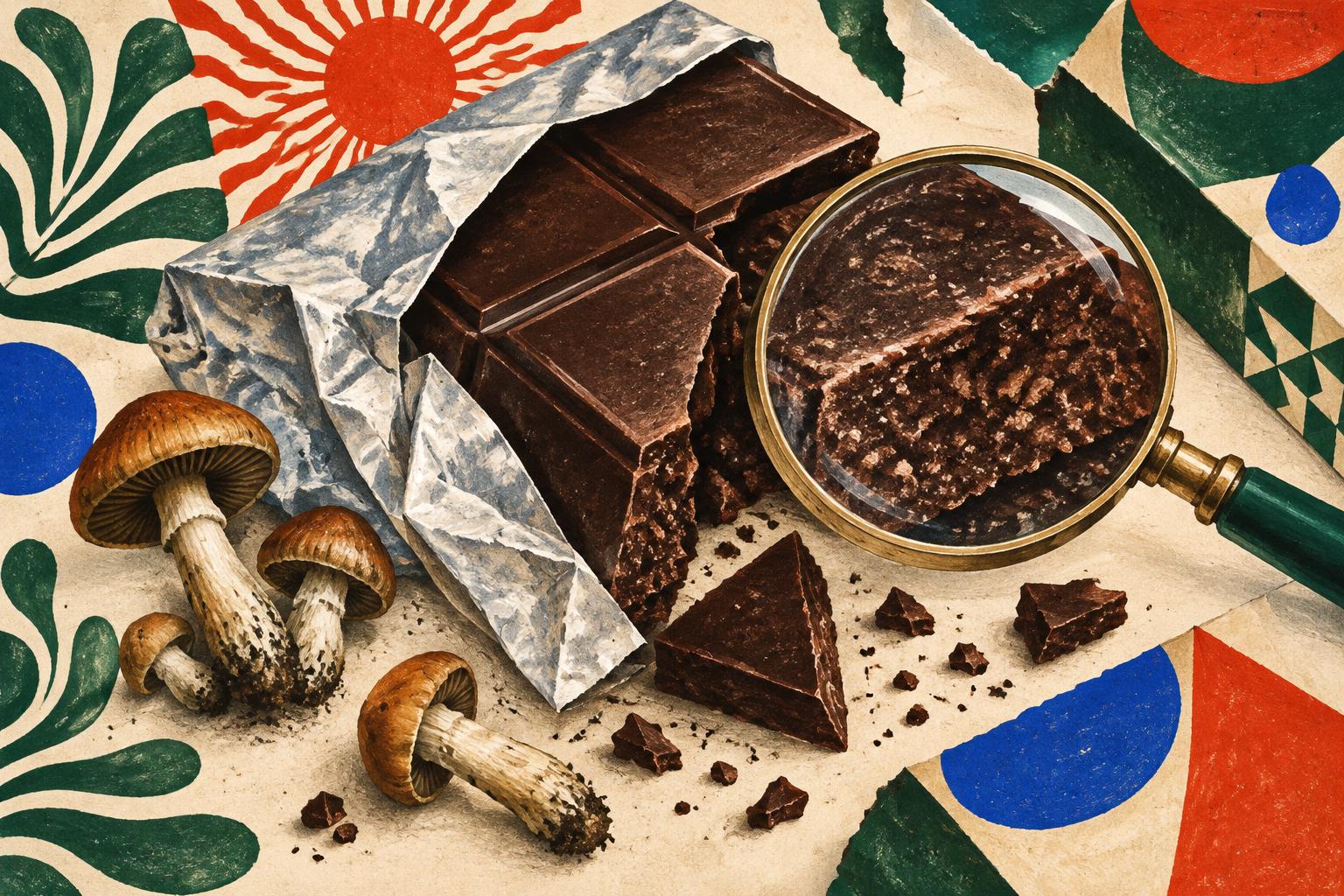
A mushroom chocolate bar can look like the easiest thing in the world to understand: chocolate, shrooms, a few squares, done. Then you turn it over and find “proprietary blend,” a cartoon astronaut, and absolutely no useful answer about what's making it psychedelic.
That's the interesting part of the mushroom-edibles boom. One shelf can hold several entirely different product categories wearing almost the same outfit.
Same format, different chemistry
Some bars contain psilocybin mushrooms. Some contain Amanita-derived ingredients, which are chemically different and don't produce the same experience. Others contain functional mushrooms such as lion's mane or reishi, without a classic psychedelic ingredient. And some tested products have contained undeclared psychoactive compounds.
“Mushroom chocolate” describes a format, not a formula. A picture of a red toadstool doesn't settle it. Neither does “magic,” “legal,” or “nootropic.” If a product is psychoactive, the useful question is which compound is responsible—and whether the label actually names it.
The Colorado story is more than internet gossip
In a March 2026 report from CU Anschutz, pharmacologist David Kroll described testing of PolkaDot-branded bars found in Denver. Labels listed non-hallucinogenic mushroom blends, but tested bars contained psilocybin, psilocin, and synthetic tryptamines.
That finding doesn't identify the contents of every bar carrying that name. In fact, the packaging problem is part of the story: Kroll reported that branded wrappers could be bought separately and filled by unrelated sellers. Matching artwork is not proof of a matching manufacturer, recipe, or batch.
Retailers can get caught in that confusion too. An invoice from a wholesaler tells you where a box came from. It doesn't necessarily tell you what a laboratory would find inside it.
Synthetic doesn't automatically mean fake—but hidden matters
“Natural versus synthetic” makes an easy headline. Transparency is the more useful dividing line.
A disclosed, identified compound and an undeclared ingredient are not the same proposition. If the package sells you one experience while delivering a different chemical, you can't make an informed choice about the product. Nor can you sensibly compare it with dried mushrooms or another bar.
That also means a strong experience is not evidence of authentic mushroom content. Feeling something tells you the product did something. It doesn't tell you what was in it.
Read the report, not just the QR code
A certificate of analysis, often called a COA, is useful when it answers the right questions. Before treating one as proof, look for:
- A matching batch or lot number. A report for a different batch doesn't establish this bar's contents.
- An identifiable laboratory and test date. A cropped screenshot with no context is weak evidence.
- Named compounds and quantities. “Pass” alone doesn't tell you what was measured.
- The scope of testing. A heavy-metals test is not a psilocybin-potency test. A potency test is not a screen for every possible adulterant.
A QR code is a doorway to evidence, not evidence by itself. Even a genuine report can't rule out substances the lab didn't test for.
Better questions make better shopping
Ask who made the product, which active ingredients it contains, and whether the report applies to the finished bar you are holding. A good answer should get more specific, not more mystical.
This isn't an argument against mushroom shops or edibles. Both are a real part of the scene. It's an argument for treating a psychedelic product like something worth understanding, rather than letting the wrapper do all the talking.
For the chemistry behind two common categories, read Amanita vs. psilocybin.
Source notes
This article draws on David Kroll's CU Anschutz report, March 19, 2026. Findings concern the products tested, not every mushroom chocolate or every seller.
Questions & answers
2 answeredThe most common questions we hear on this topic.
Does mushroom chocolate always contain psilocybin?
No. The term can refer to psilocybin, Amanita-derived ingredients, non-psychedelic functional mushrooms, or other formulations. The product name alone doesn't identify its contents.
Does a QR code prove a mushroom bar is tested?
No. Check the linked report's lab, date, batch number, named compounds, and testing scope. A report for another batch or for contaminants alone does not verify the bar's active ingredients.